
I cannot share all information about the development, design, programming and implementation of the Tapp water app yet, but some details you can find below.
What is the app about?
The Tapp water app is a smart, open-access app, which contributes to the use, acceptance, operation and maintenance of piped water supply systems in Bangladesh. Via the Tapp app communities and water suppliers can now connect to each other, participate in, learn about and provide feedback on their own piped water supply systems. Best of all, in a modified way, the app can be applied to other areas around the world to do exactly the same thing.
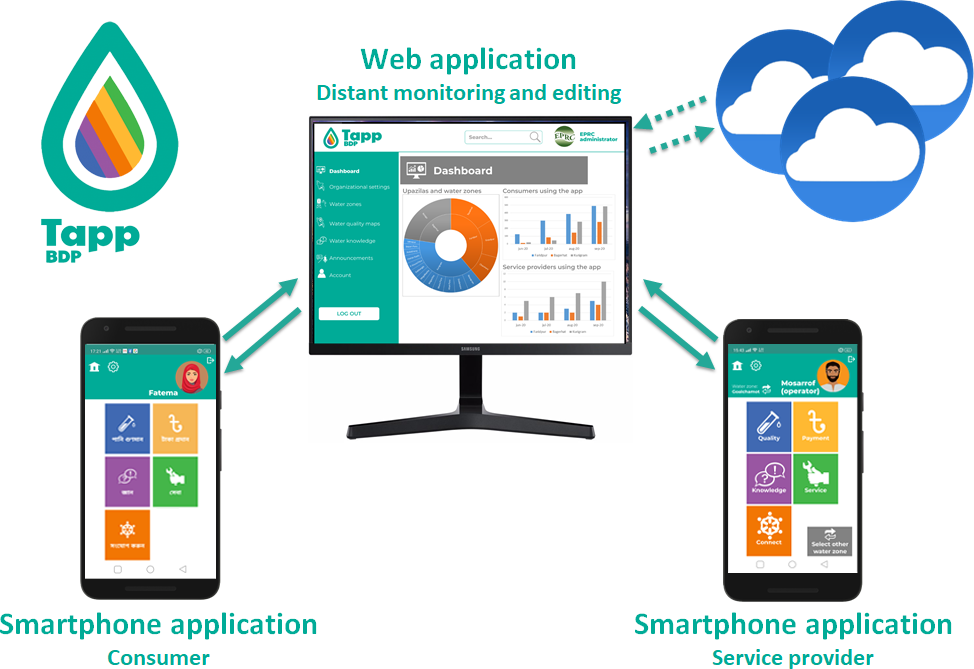
The Tapp water app consists of two smartphone applications: one for the water service provider and one for the consumer. And also a web application for distant monitoring and editing. The Tapp app is unique in combining five different domains, where most water apps focus either on service and payment or on water quality. The Tapp domains include: water quality testing, knowledge, connect, payment and service delivery. The app is intended for piped water supply systems, but also includes water quality testing and service for hand-pumps. Special attention is given to usability, usefulness and desirability of the app.
Why is the Tapp water app relevant?
According to the United Nations Sustainable Development Goal 6, in 2017 still 2.2 billion people lacked safely managed drinking water. Solutions for safe drinking water are urgently required to promote health, reduce poverty and boost economic growth worldwide. Piped water supply is a promising solution to deliver safe drinking water to households, as water quality and treatment are easier to control and the water is less likely to be contaminated between collection and consumption. Thereby, taps inside the house or courtyard are also very much desired. However, costs, trust issues, intermittent supply, installation time, billing, lack of operation and maintenance are obstacles for the uptake of these piped systems.
If local communities and local stakeholders would play a more important role in developing and managing these piped water supply systems, this will definitely help to improve their use and acceptance, as well as their operation and maintenance. As in Bangladesh smartphone ownership and internet access are rapidly growing, we used a mobile crowd participation approach to empower local stakeholders to take ownership of their own drinking water supply.