
DELTAP project: Small-scale piped water supply in the Ganges-Brahmaputra-Meghna Delta
Faculty of Civil Engineering and Geosciences
Urbanization of deltas puts a severe stress on availability of clean, safe drinking water and therefore threatens the lives of millions, mostly affecting the poorest. Water supply in the Ganges-Brahmaputra-Meghna Delta (GBM Delta) in India and Bangladesh is predominantly organized through the use of scattered household hand-pumps, where the water safety is un-controlled, leading to contaminant exposure. Thereby, arsenic-contaminated groundwater, causing a widespread, serious health risk exposing millions of people worldwide (Smith et al., 2002; Chowdhury, 2010), is a serious problem in the GBM Delta (Acharyya et al., 2000; Nickson et al., 2000; Acharyya and Shah, 2006). And to date, arsenic mitigation strategies have collectively disappointed, due to the financial, institutional, environmental, technical and social complexity of the arsenic problem.
Centralized water supply through Small-scale Piped Water Supply (SPWS; IRC, 1981, Ahmed, 2002, Trifunovic, 2002, WHO, 2005) offers crucial advantages over other technological interventions, as:
- It targets the safest source in the area;
- It provides a degree of centralization (<100 households) for water quality control and treatment;
- It provides in-house or courtyard tap connections, which are socially-economically desirable, as it saves time and effort to collect the water and it enables easy washing and cleaning;
- It limits the number of (re-)contamination events between water collection and consumption.
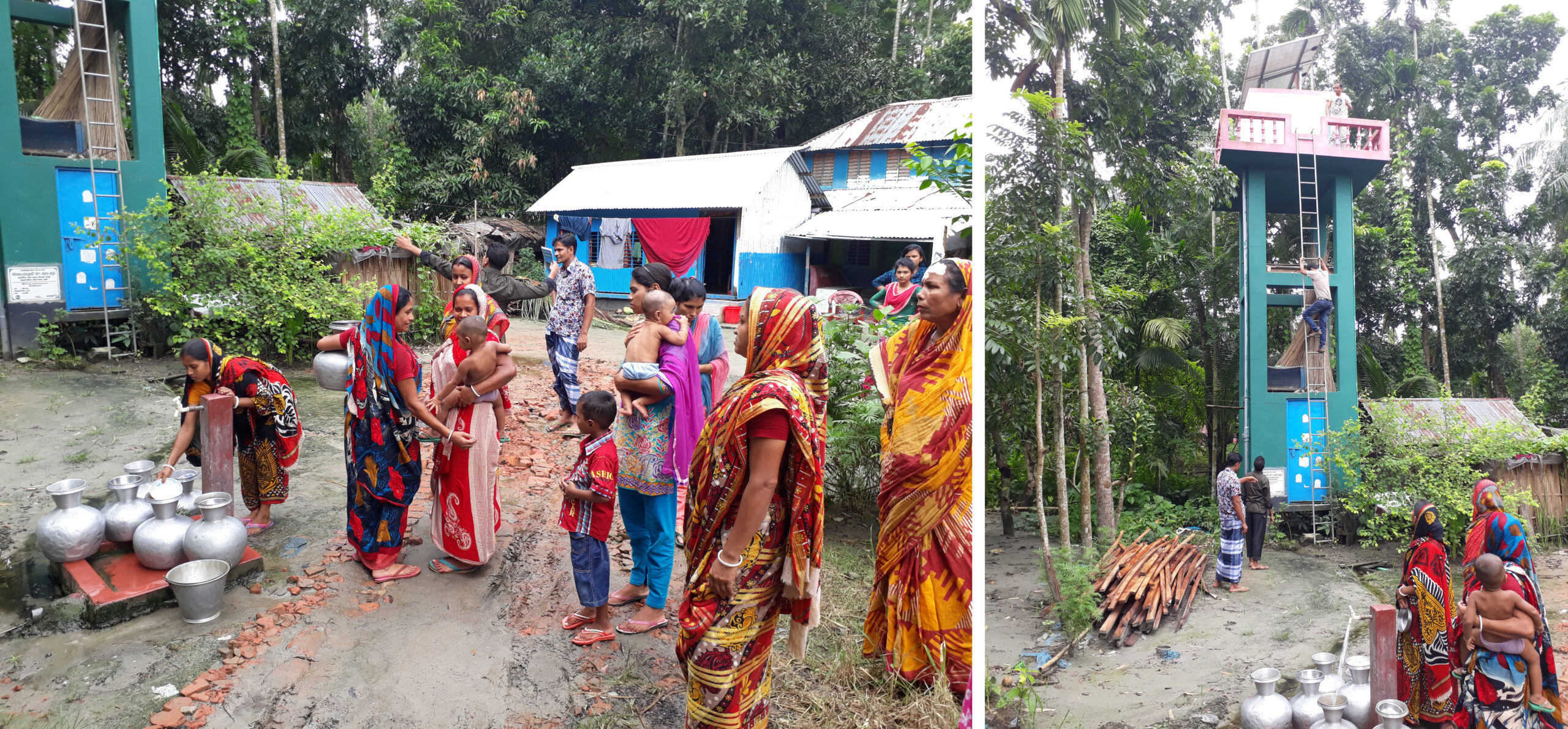
According to Dreibelbis et al., 2013, the success of interventions to improve water, sanitation and hygiene practices ultimately rests on the ability to foster and maintain behavior change. To improve the accessibility, applicability, acceptance and adoption of the SPWS system, the end-users and other stakeholders should be included (Donaldson 2009; Nakata and Weidner 2012; Prahalad 2012; Robertson and Simonsen 2012; Wilkinson and De Angeli 2014). Stakeholder interaction and participation leads to a thorough understanding of the social, technical and economic factors that play a role in the region. In the end, end-users determine the (changing) water demand and can guarantee rootedness in the local context.
Aim of this project
To involve potential end-users in research and monitoring of the water supply system, Mobile Crowd Participation (MCP) can be deployed. Mobile phones are more and more used to “collectively share data and extract information to measure and map phenomena of common interest” (Ganti, Ye, and Lei 2011). This is called ‘Mobile Crowd Sensing’. Mobile Crowd Participation means not only extracting information from participants, but also to interact with end-users to empower them to participate and take control into these phenomena that affect their own lives.
In this research, the MCP tools rely on mobile phone applications (apps), which can be utilized for end-user interaction, water quality analyses, behavioral change studies, real-time monitoring, and also facilitates a dialogue with the end-user, both pre- and post SPWS implementation. Access to mobile services in the developing world has outpaced the rate at which much of the population is gaining access to basic services such as electricity, sanitation, and banking (GSMA, 2013). And mobile phone coverage has increased rapidly over the past decade in Bangladesh and India.
The main research goal of this project was: Investigating the possibilities and added value of using Mobile Crowd Participation as a research tool for water projects in developing regions.
Research activities
The following research activities have been executed in India and Bangladesh:
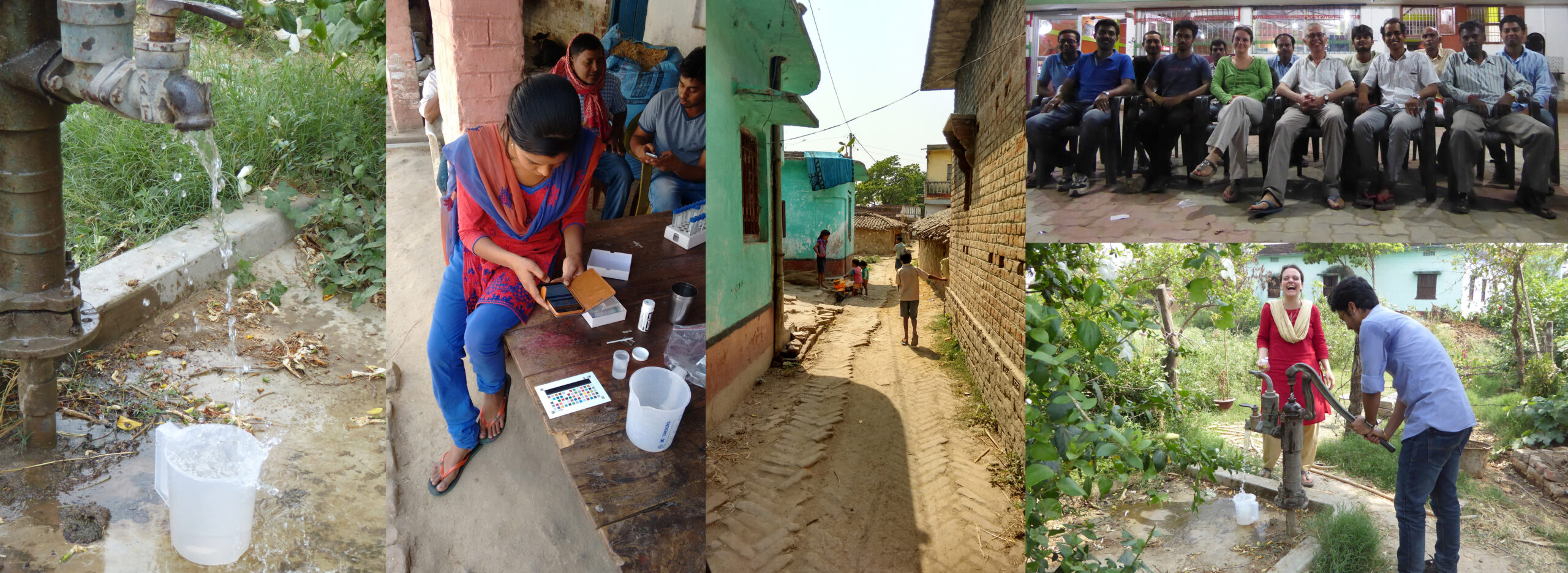
In 2017 in 7 villages in Bihar, India:
- Tested 335 tube-wells
- Conducted 60 in-depth interviews
- Conducted 275 questionnaires
- Provided 60 households with water quality testing trainings to explore the possibility for water quality screening by communities.
In Bangladesh in 2014 / 2015 / 2017 /2018:
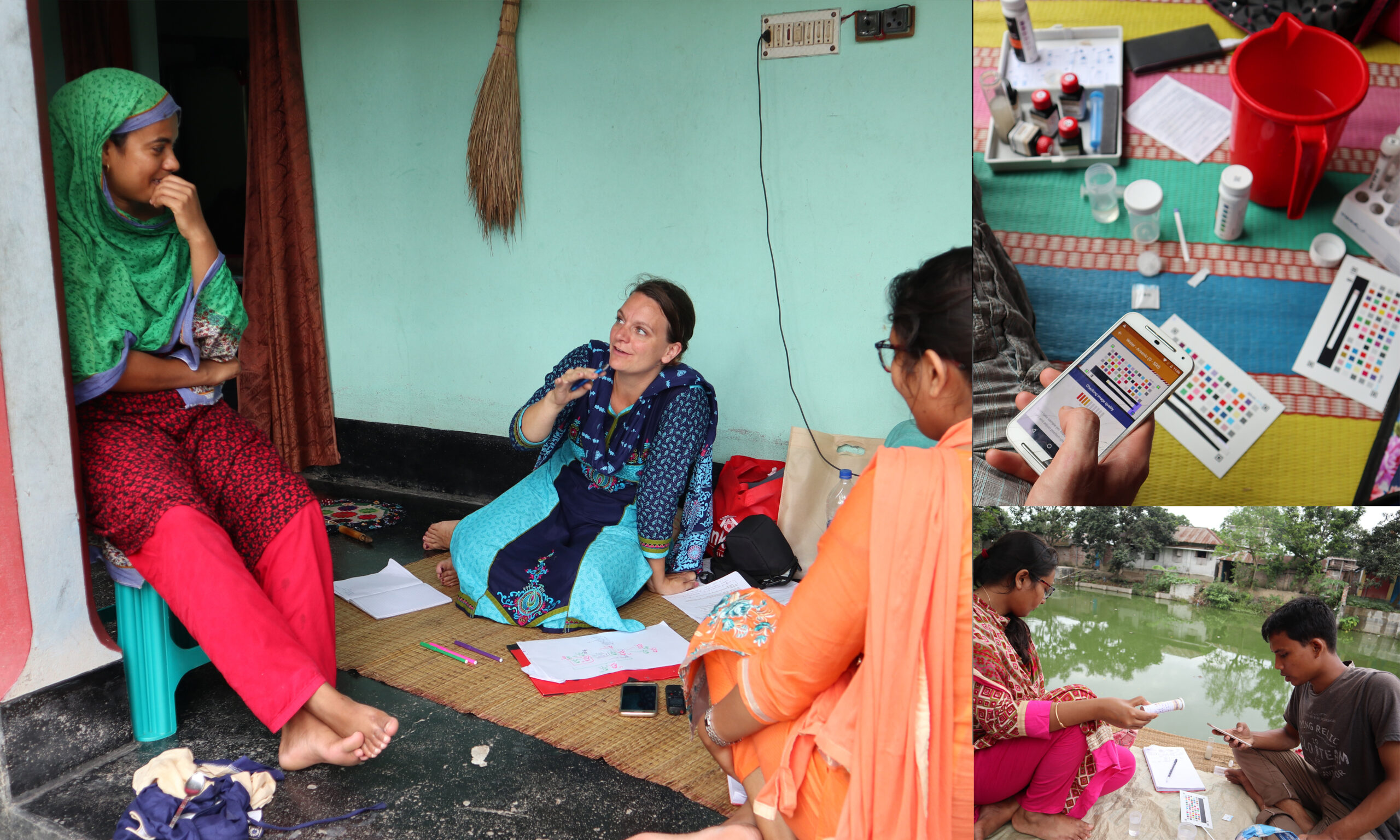
- Tested 140 tube-wells in 4 villages in Rajshahi
- Conducted 601 questionnaires in Satkhira, Bagerhat and Khulna
- Conducted 101 questionnaires in Koloroa and Debiddar
- Conducted 42 in-depth interviews with a variety of stakeholders and end-users in Rajshahi, Manikganj, Narail, Patuakhali
- 12 focus group sessions in Rajshahi, Manikganj, Narail
Main outcomes of this project
The main project outcomes are:
- Requirements for Small-scale piped water supply projects:
- Should have at least 3 operators, appointed by the elderly.
- The operators should be young and knowledgeable / trusted.
- The system should be situated in a public area to avoid disturbance and exclusion. Currently some people are excluded from fetching water from safe pumps.
- The piped system is very convenient for women, and therefore desired by them. But most financial decisions are taken by men.
- Everyone agrees that the people with the worst water quality should receive piped water first.
- Costs might be an issue, although one men shared: ‘when people can buy beef, they can also pay for water’. Willing to pay 100 to 200 BDT per month.
- Needs to be well maintained and operated
- There is a willingness to use piped water supply, but there are several issues as well:
- Cost
- Operation and maintenance, management
- Water quantity: intermittent supply, low water pressure, leakage
- Water quality: disinfection, filter replacement, deterioration of infrastructure
- Mainly desired for convenience, often used for taking bath and cleaning, not for drinking.
- Taste (too warm, not sweet enough)
- Trust in the piped system, in the water quality, in the water supply, and in the operator
- Billing (illegal tapping, money collection)
- Lack of knowledge of the system and of the water quality
- There is a willingness to use apps
- There is 50-90% smartphone ownership in the investigated households, and practically every household owned at least one mobile phone. There is also a rapid increase of mobile (smart)phone usage and a willingness to use internet and to pay for the internet.
- An application that supports monitoring, operation and maintenance of (piped) water supply systems in rural and peri-urban areas should contain the following functionalities:
- Water quality testing domain for field testing. For at least arsenic, iron, salinity, turbidity, microbial contamination, salinity and manganese.
- A service delivery domain to request for service or inform consumers about issues.
- A payment domain to ease money collection for the service provider.
- A connect domain to facilitate discussion on water issues and water quality
- A knowledge domain on water quality, preventive measures, and hygiene and health.
- Several app requirements. The app:
- Must facilitate usage for literate, semi-literate and illiterate users, and therefore contain pictures + text if a concrete tap or place needs to be indicated, but drawings or icons + text for all other app functionalities
- Must be easy to use. This means, among other things, that the user should reach the intended action/result with as little clicks as possible, and that the different functionalities are logically placed and therefore can easily be found and explored.
- Must be easy to understand. This means, among other things, a combination of visuals (icons) with text will be used. Further logic can come from existing, popular apps in Bangladesh.
- Must be suitable for Android phones.
- Must deliver emergency alerts to all water consumers when their phone is not connected to the internet / when they own only a feature phone (through messages?).
- Must have a login as phones are often shared between household members. However, the app should remain easily accessible, the login should not be an obstacle for using it.
- Must be programmed in English and Bangla. Both language options should be present in the app.
- Must be easy to update.
- Must be able to deliver ‘pop-up’ messages
- Should be as ‘light’ as possible, due to internet limitations and smartphone internal storage limitations. Training videos can be stored in the database, visuals should not take much space.
- Should deliver chats/discussion also when the phone is not connected to the internet / when they own only a feature phone (Facebook Messenger delivers text messages for free without internet package).
- Could make use of existing apps, such as AKVO Caddisfly, WhatsApp, or Messenger.